
PRODUCT LANDING · CONTROLLED COVERAGE SYSTEM
Waterproof Aprons and Work Capes Built from a Controlled Coverage Brief
EverBen develops bulk apron, sleeve-smock and work-cape programs from the buyer’s work pattern, contact direction, open-zone map and service route—not from a generic waterproof label.
A useful request identifies what the wearer does, where liquid arrives, which body zones must stay covered, how gloves and tools interact, and whether the article is cleaned, reassigned or discarded. We turn that operating picture into a revision-controlled construction, sample route, evidence plan and pack specification. The same file also separates observations from represented performance: silhouette photographs support geometry review, coded swatches support identity, complete samples support fit and handling review, and method-specific records support only the statements within their stated scope. Keeping those roles separate gives purchasing, quality and end-use teams a clearer basis for approval and later change control.
01 · OPERATING INPUT
Describe the Work before Naming the Garment
Apron, smock and cape shapes solve different coverage problems. Begin with the event and movement sequence so the first drawing reflects the real workstation.
01
Liquid and residue
List water, detergent, food residue, oil, dye or other media by exact name. Record temperature, concentration and whether contact is mist, splash, run-off or repeated wet handling. A broad category cannot support a material decision.
02
Contact direction
Map front, side, overhead and bench rebound paths. Note whether liquid reaches the chest, lap, forearms, shoulders or back. Direction decides where panels, joins and open edges deserve attention.
03
Movement sequence
Document reaching, bending, turning, sitting, lifting and tool use. Include the longest shift posture and the fastest repeated motion. A static front photograph will not reveal every clearance problem.
04
Workstation limits
Record chair backs, conveyor edges, hooks, heat sources, rotating parts and narrow passages. The pattern must avoid snag points and allow safe removal within the buyer’s operating procedure.
02 · COVERAGE ARCHITECTURE
Choose Bib Apron, Sleeved Smock or Work Cape by Open Zones
Coverage is a geometry decision. Compare complete silhouettes against the required body zones, then record every deliberate opening.
01
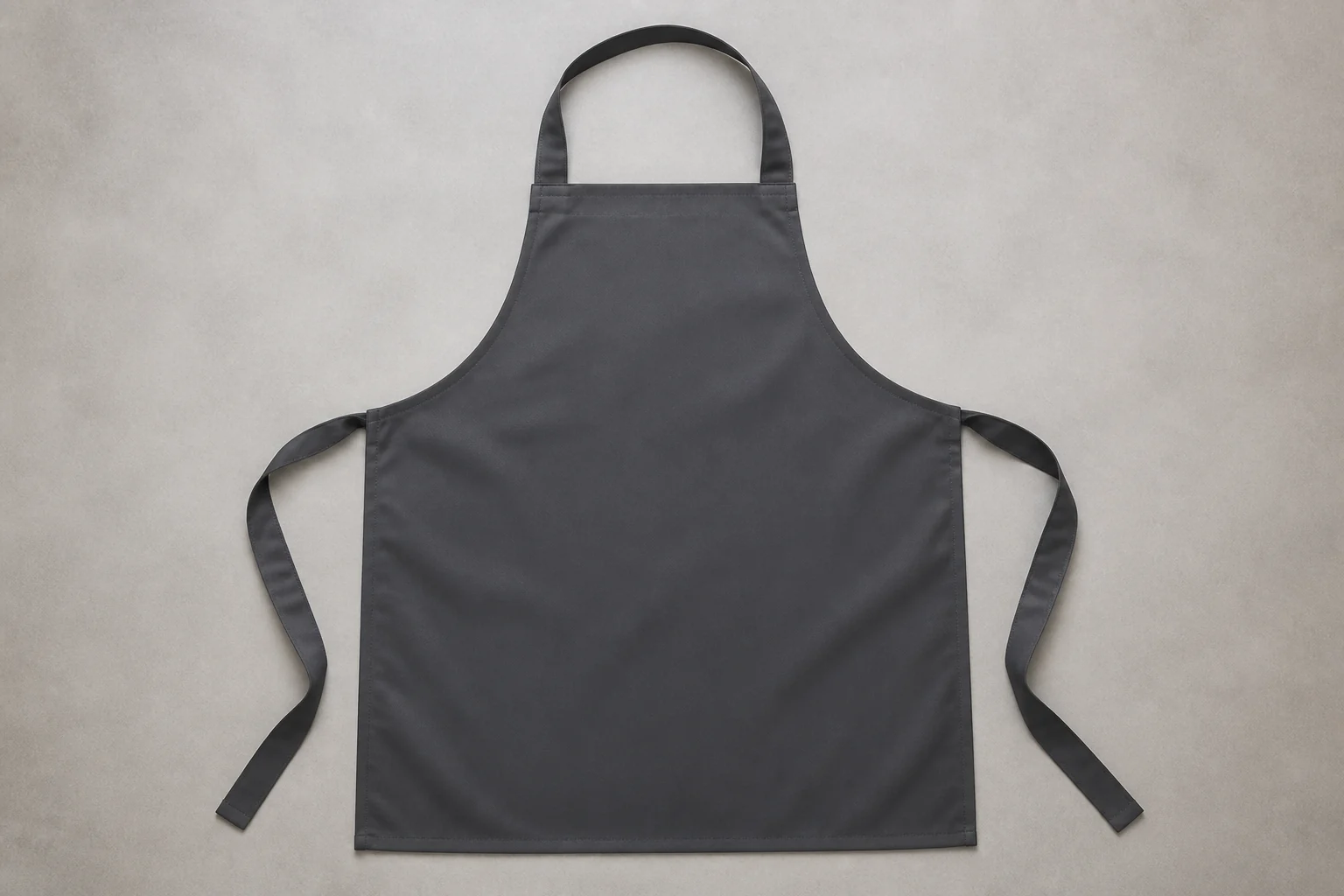
Bib apron
A front-hanging bib can protect the torso and upper legs while leaving arms, sides and back open. Define bib width, lower length, neck route, waist ties and any split or pocket without implying whole-body protection.
02
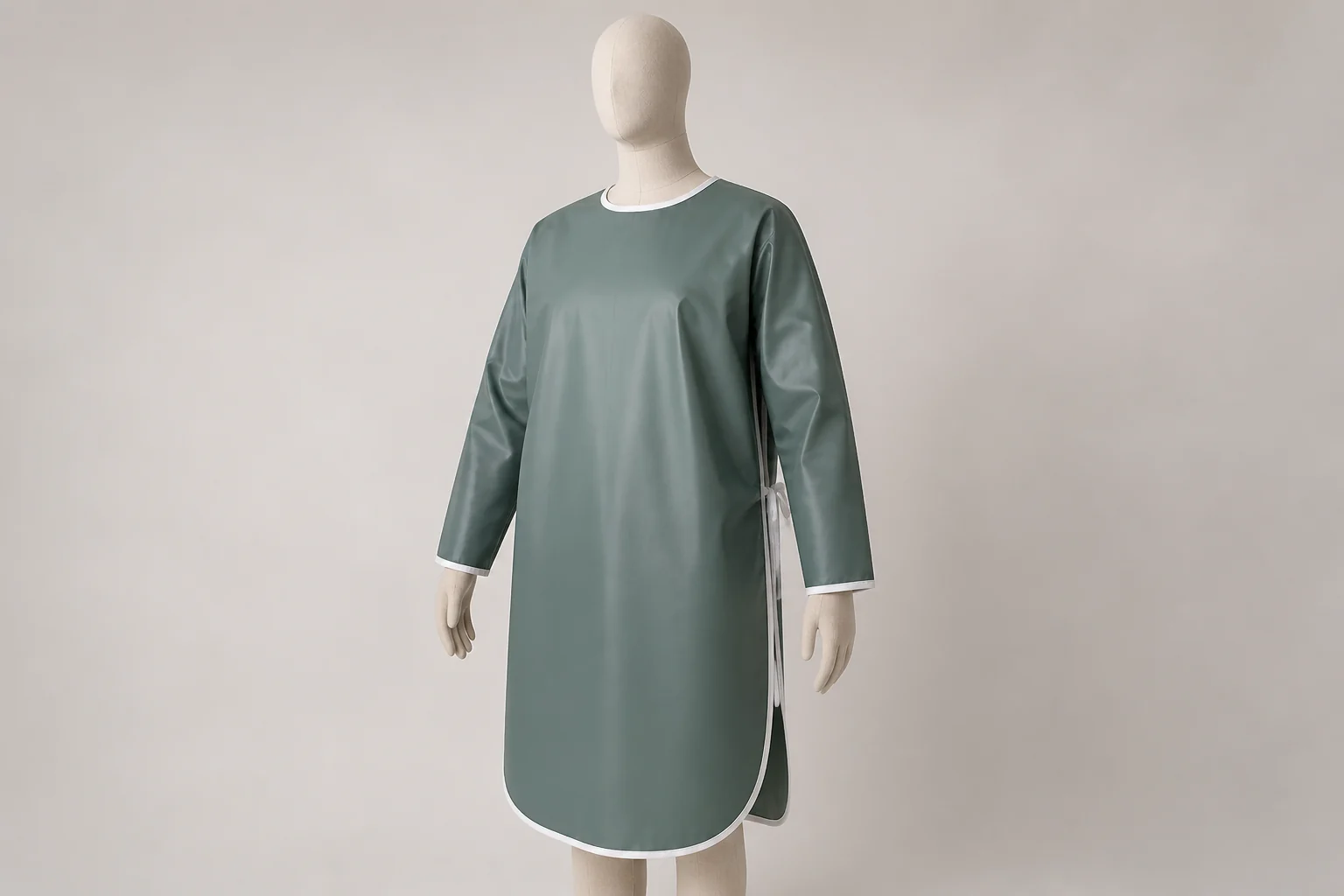
Sleeved smock
A long-sleeve over-garment extends coverage across shoulders and arms. Specify cuff shape, side or rear opening, overlap, hem, fastening and the interface with gloves or inner clothing.
03
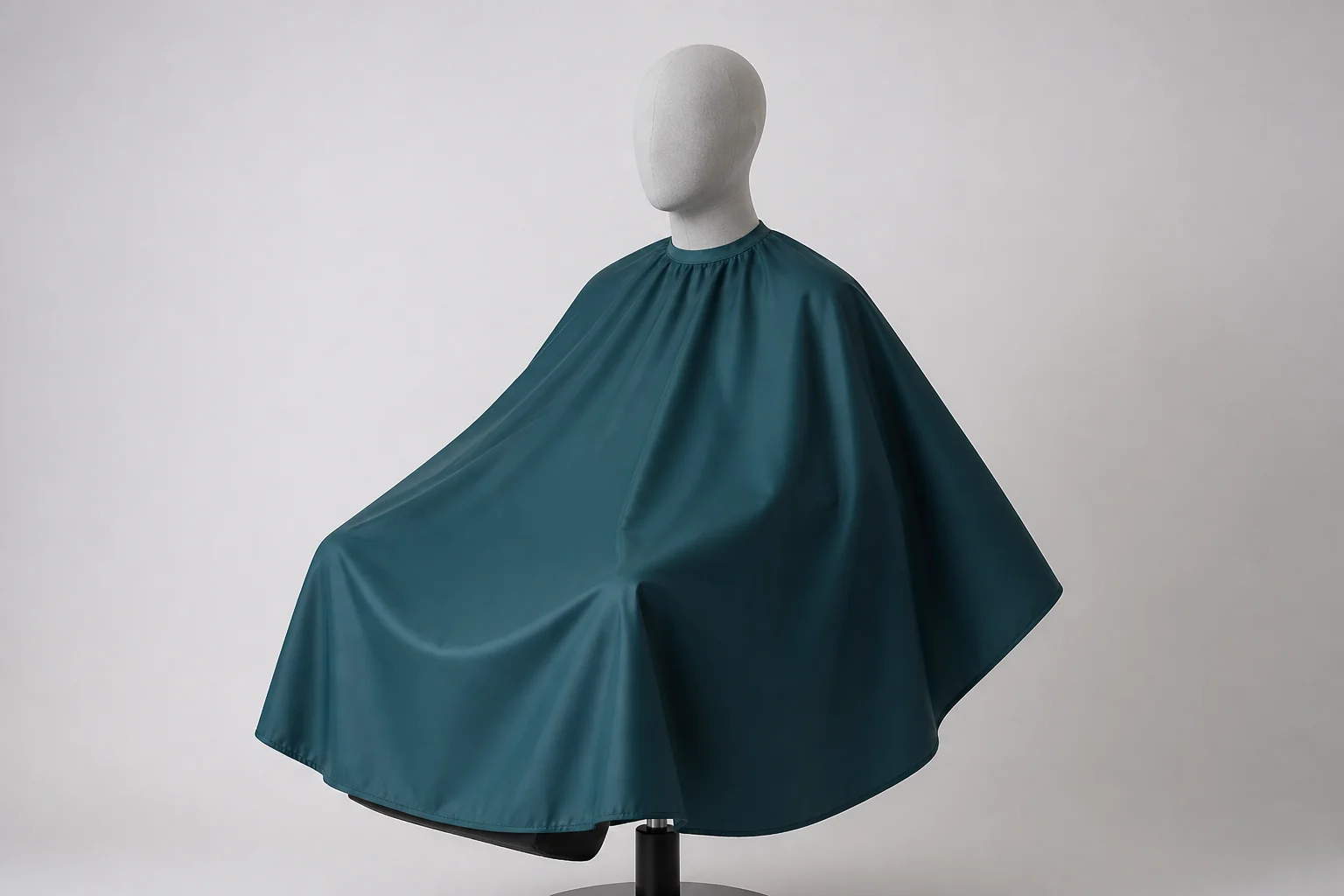
Draped work cape
A cape can cover shoulders and the upper body for grooming, service or controlled wet work. Define neck closure, hand exits, front overlap, chair clearance and removal direction for the exact task.
04
Hybrid program
One buyer may need separate SKUs for wet production, cleaning and grooming. Keep each architecture, claim boundary and packing code distinct rather than forcing unlike tasks into one universal article.
03 · LAYER DECLARATION
Specify the Whole Coated-Fabric or Film Route
Material family names hide important differences. Describe the outside-to-inside build and link the declared code to the offered sample.
| Entity | Attribute | Buyer record | Release question |
|---|---|---|---|
| Work event | Medium, direction, duration and motion | Exposure card | Does the architecture cover the mapped zones? |
| Layer build | Base, coating or film, face and code | Declaration plus coded swatch | Is the represented construction exact? |
| Finished article | Pattern, joins, edges and closures | Drawing plus complete sample | Were all interfaces reviewed? |
| Care route | Media, dilution, cycle, rinse and drying | Controlled procedure | Was the complete construction assessed? |
| Pack and continuity | Fold, label, carton and change notice | Sealed reference and release file | Can a reorder be compared reliably? |
01
Base and barrier
State whether the construction is unsupported film, coated woven fabric, laminated textile or another declared route. Record which face meets the work environment and which face contacts the wearer or underlying clothing.
02
Mass or thickness
Choose the relevant unit, conditioning and measurement method before setting a number. Keep raw film, coated roll goods and finished-garment measurements from being compared as though they were identical.
03
Surface and hand
Define gloss, matte, emboss, color and acceptable drape with a physical reference. These visual and handling attributes are observations, not proof of resistance to an unnamed liquid.
04
Traceable material code
Assign a buyer-readable code to the accepted roll construction and retain a signed swatch. A later substitution, coating-side change or colorant change should trigger documented review.
04 · CONSTRUCTION CONTROL
Resolve Joins, Edges and Fastenings as One System
The field material is only one part of the finished article. Edge finishing and attachment points often experience the greatest local stress.
01
Join map
Show sewn, welded, taped, bonded or folded joins on the drawing. If two methods are combined, identify the sequence and side. Evidence for flat material does not automatically describe the finished join.
02
Neck and waist
Specify fixed loop, adjustable strap, tie, buckle, snap or hook-and-loop route with dimensions and attachment reinforcement. Confirm donning, adjustment and release with representative wearers.
03
Cuffs and hand exits
Define elastic, straight, knitted or adjustable cuffs, or the size and position of cape hand openings. Record how gloves, tools and sleeves overlap during the complete motion cycle.
04
Edges and pockets
Approve binding, turned edge, welded edge, split hem, pocket type and drainage logic deliberately. Added components can create new retention points, punctures or cleaning work.
05 · WEARER RANGE
Approve Fit through Motion and Adjacent Equipment
Finished dimensions must work on people, not only on a cutting table. Use a wearer range and task sequence to judge usable coverage.
01
Size logic
Define one-size or graded sizing with reference body dimensions and garment measurements. Record adjustable ranges separately from nominal labels and confirm how the extremes of the range are evaluated.
02
Motion trial
Observe reach, bend, sit, turn and lift movements on the intended wearer range. Check hem rise, side exposure, neck migration, cuff pull and tie tension without treating comfort as a single subjective score.
03
PPE interfaces
Trial gloves, boots, sleeves, face protection and other required equipment together. An overlap that looks sufficient at rest may separate when the wearer reaches or rotates.
04
Tool clearance
Include hoses, knives, brushes, clippers, trays or handheld tools used in the job. Confirm that straps, pockets, hand exits and hem geometry do not interfere with the buyer’s procedure.
06 · SERVICE MODEL
Bind Cleaning, Inspection and Reuse to the Offered Construction
A reusable program needs a controlled after-use route. A disposable program needs equally clear removal, segregation and disposal instructions.
01
Cleaning media
List water temperature, detergent or disinfectant identity, concentration, contact time, mechanical action and rinse route. Compatibility must be validated for the exact finished article and proposed procedure.
02
Drying and storage
Define hanging, flat drying, ventilation, allowable heat and storage separation. Packaging the article while damp or sharply folded can change the condition presented at the next use.
03
Inspection points
Check field material, joins, edges, straps, closures and markings after the accepted care cycle. State removal-from-service criteria so damaged items do not continue by habit.
04
Assignment model
Record whether articles are individually assigned, pooled, laundered by a contractor or discarded after a task. Labeling and pack counts should support the selected control model.
07 · IDENTIFICATION
Keep Artwork and Marking inside the Claim Boundary
Branding, size identification and care information must remain legible without becoming unsupported safety language.
01
Artwork location
Place print, transfer, label or emboss zones on the pattern and identify the visible face. Review whether the process adds holes, heat, stiff areas or cleaning constraints to the construction.
02
Revision ownership
Use controlled artwork files with color references, dimensions and approval dates. Separate customer branding from product identification and internal trace codes.
03
Care communication
Write only instructions supported by the accepted material and finished-garment route. Avoid importing generic wash symbols or temperature statements from unrelated constructions.
04
Claim approval
Route words such as chemical resistant, food safe, compliant or certified through destination-specific evidence review. A logo file is not permission to print an unverified performance statement.
08 · SAMPLE LADDER
Move from Swatch to Packed Pre-Production Article
Each sample stage answers a different question. Define the decision and acceptance record before asking the factory to make the next stage.
01
Material swatch
Confirm color, face, hand and declared construction against a coded reference. A swatch cannot validate fit, closure position, join behavior or packed recovery.
02
Pattern sample
Review coverage geometry, dimensions and motion using the proposed pattern and closure route. Mark changes on one dated revision rather than splitting comments across messages.
03
Evidence specimen
Agree whether testing concerns roll goods, a join coupon or the complete garment. Preserve specimen identity, conditioning, method and result with the accepted SKU record.
04
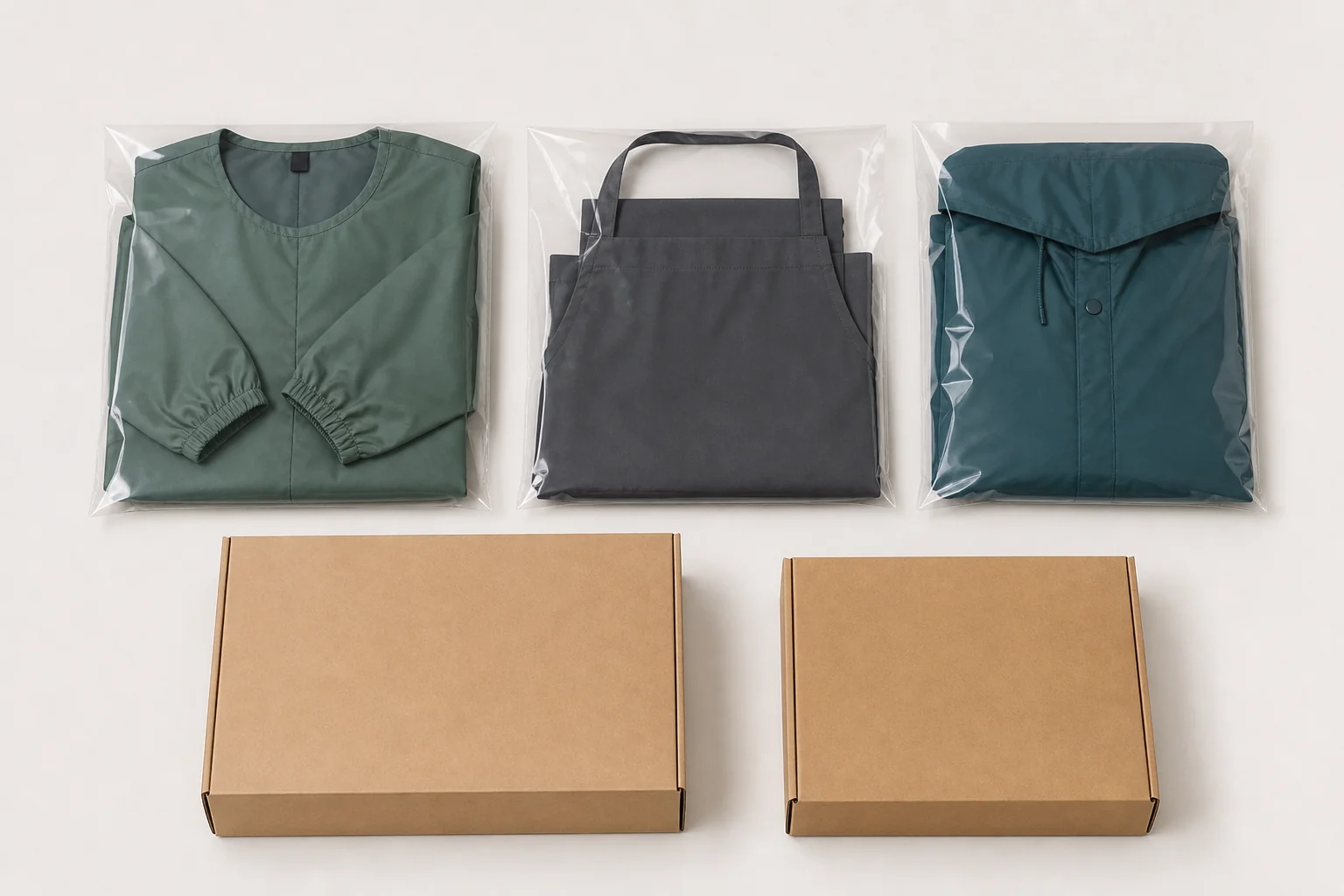
Packed pre-production
Approve the finished article after labeling, folding, unit packing and carton loading. This stage verifies presentation and logistics conditions that loose samples do not reproduce.
09 · BULK RELEASE
Inspect the Finished Program and Its Packing
Bulk control should follow the accepted drawing, sample and evidence file. It should not rely on a new visual interpretation at shipment time.
01
Incoming identity
Check delivered roll and component codes against the approved bill of materials. Record any source, shade, face or lot change before cutting begins.
02
In-process checks
Monitor critical dimensions, join placement, edge finish, strap attachment and artwork position at defined operations. Early records make correction more practical than end-only inspection.
03
Final article
Inspect complete pieces for construction, measurements, operation, appearance and approved marking. Use the buyer’s acceptance plan and keep any represented test separate from routine visual checks.
04
Pack allocation
Verify fold, unit pack, label, quantity, carton strength and destination split against the released packing file. Retain one sealed reference when continuity matters.
10 · COMMERCIAL NORMALIZATION
Request Quotations against the Same Controlled Object
Price comparison becomes useful only after suppliers quote the same architecture, material, evidence, sample work and packing scope.
| Field | Supplier response | Buyer decision |
|---|---|---|
| Architecture | Required, offered, alternative or open | Confirm complete form and openings |
| Material | Exact layer description and code | Attach declaration and physical reference |
| Evidence | Specimen, method, result, date and scope | Applicable, informative, gap or review |
| Samples | Swatch, coupon, complete and packed stages | Assign owner and acceptance gate |
| Commercial scope | Included work, exclusions and departures | Normalize before comparing total cost |
Connect every proposed statement to the offered SKU
Follow the relationship through the exact construction, represented specimen, method, outcome, date, destination and responsible decision owner.
Keep informative records visible but separate
A third-party result or material guide may improve questions without proving the offered finished article.
01
Required versus offered
Ask each supplier to mark every line required, offered, alternative or open. Narrative promises should not conceal a different material, closure or evidence assumption.
02
Included work
Identify sampling, testing, tooling, artwork, labels, packaging and inspection in the quotation. Keep optional services visible rather than burying them in a unit price.
03
Departure schedule
List every proposed difference from the buyer brief with its reason and decision deadline. An unrecorded alternative can become an accidental bulk specification.
04
Reorder continuity
Require change notice for material, component, method, source or pack changes. Compare the reorder to retained references and the latest released file, not only to the product name.
Evidence boundary for this page
This page does not promise universal waterproofness, chemical resistance, food or medical suitability, certification, care life, minimum order, price or delivery. Any represented statement must remain attached to the exact accepted construction, evidence, destination and project revision.
Buyer FAQ
Questions to close before an apron or cape release
Which form should an importer specify first?
Choose only after mapping contact direction, required body zones, deliberate openings, movement and adjacent equipment. A bib apron, sleeved smock and work cape are not interchangeable descriptions.
Can a coated-fabric name prove chemical protection?
No. The buyer must identify the chemical or medium, concentration, temperature, contact mode, specimen, method and acceptance basis. Material naming alone is not finished-garment evidence.
What information is needed for a reusable apron program?
Define the exact cleaning chemistry, temperature, mechanical action, rinse, drying, inspection and removal-from-service route, then validate it on the proposed finished construction.
How should quotations be compared?
Issue the same controlled brief covering architecture, dimensions, layer stack, joins, closures, artwork, sample stages, evidence, quantity and packing. Require suppliers to list departures explicitly.
Does EverBen promise one universal MOQ or lead time?
No. Commercial terms depend on the accepted construction, material availability, color, components, sample and evidence work, packing, quantity and destination.
What should be retained for reorders?
Keep the released brief, accepted complete article, coded material swatch, artwork, evidence index, inspection record, sealed pack reference and approved departure schedule.
Controlled next step
Convert the Workstation into One Reviewable Apron or Cape File
Send the task, media, contact direction, coverage map, construction preference, wearer range, care route, artwork, quantity, destination and evidence questions. We will identify open decisions before preparing a quotation route.