
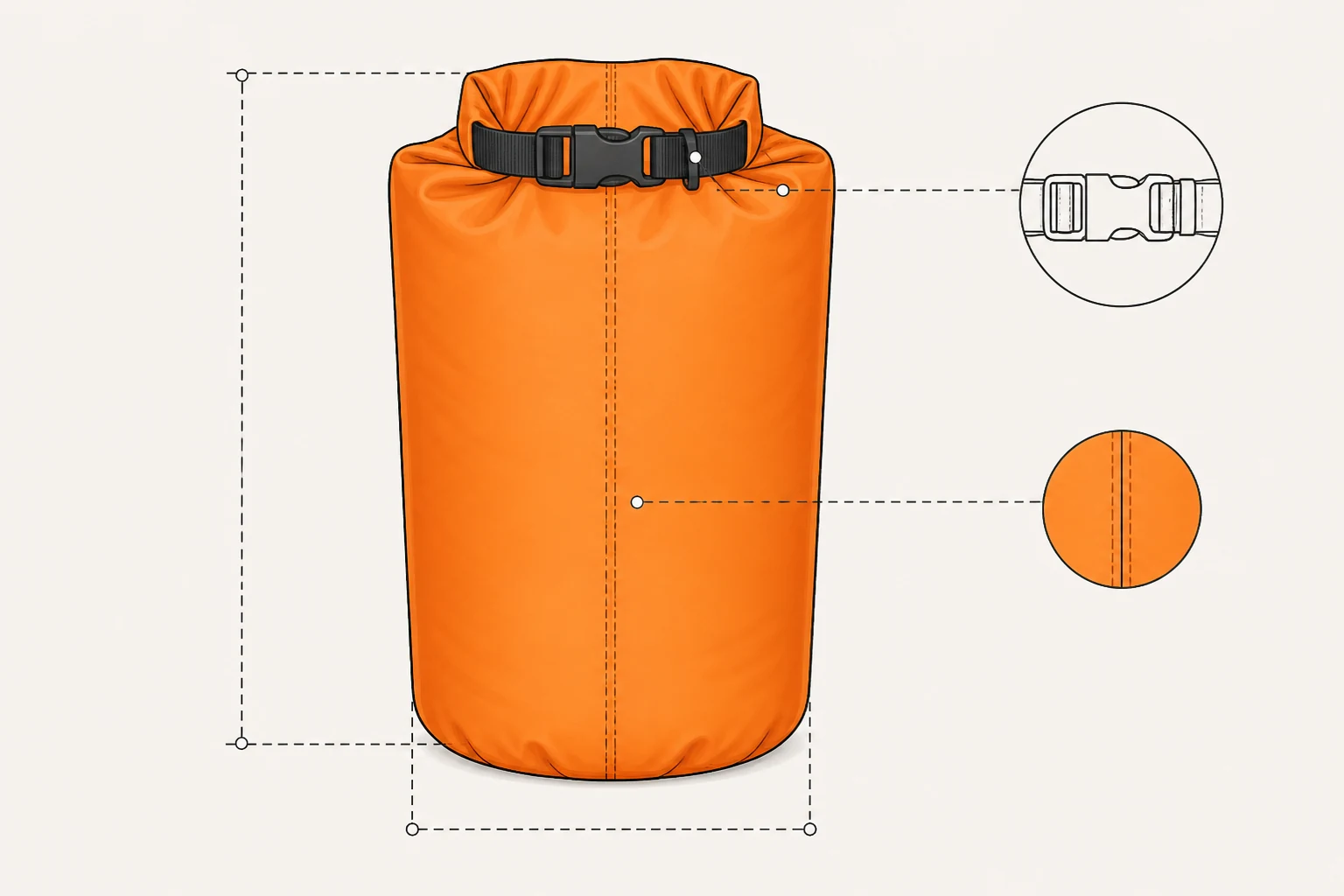
BUYING GUIDE / OUTDOOR DRY BAGS & ROLL-TOP SACKS
How to Specify Dry Bag Fabric, Coating and Roll-Top Construction
A coated fabric and roll-top mouth do not automatically make a bag submersible. Buyers must define exposure, closure procedure, seam route, contents, test method, capacity convention and permitted claim before comparing dry-bag offers.
This guide connects coated textile identity, welded or stitched seam construction, roll-top stiffness, buckle geometry, carrying hardware, capacity and packing. It separates splash and short-exposure protection from unsupported immersion, rescue or guaranteed-float claims.
01 / exposure and claim
Define contents, exposure and closure behavior before using waterproof language
Protection language should describe a complete bag under a defined procedure. Procurement must identify how water can reach the bag, how long exposure lasts, what is packed and how the roll-top is closed.
- 01Define contents and exposure
- 02Name closure procedure
- 03Select finished-bag method
- 04Freeze allowed wording
01
Map the exposure route
Record rain, spray, deck splash, puddle contact, wet-ground use, repeated opening, brief accidental wetting or another buyer-defined condition. Keep immersion and pressurized exposure outside the claim unless explicitly validated.
02
Define the contents and consequence
Identify clothing, documents, tools or other approved contents, their sensitivity, packing density and acceptable outcome. Do not imply protection for electronics, medicines, food or safety-critical items without an exact controlled scope.
03
Write a bounded claim
Connect fabric, seam, closure procedure, loading, orientation, conditioning, test method and acceptance criteria. Replace vague waterproof guarantees with language supported by the complete finished-bag evidence.
02 / textile and coating
Specify the woven base, coating or laminate and surface orientation as one material system
A supplier phrase such as coated nylon is incomplete. The construction record should identify the textile, coating or film, application face, mass basis, color and seam compatibility used in each panel.
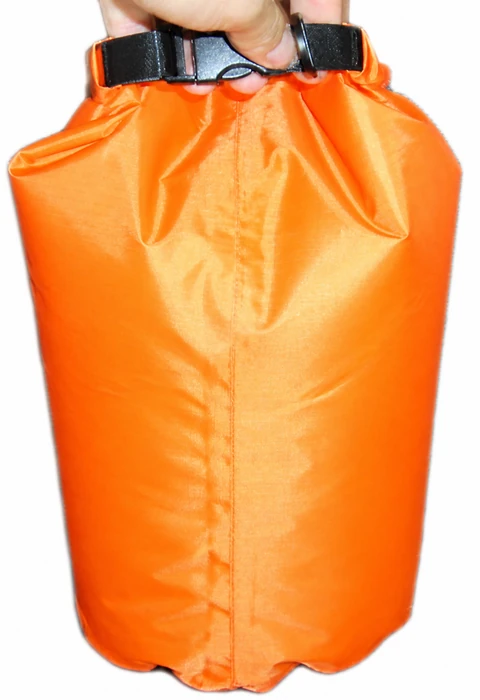
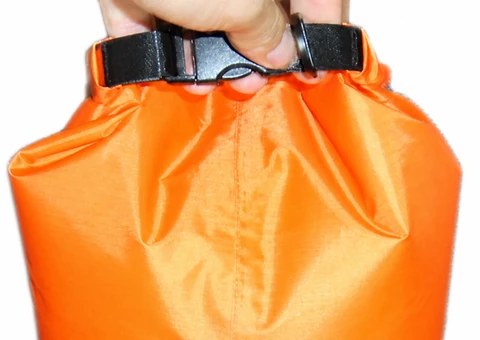
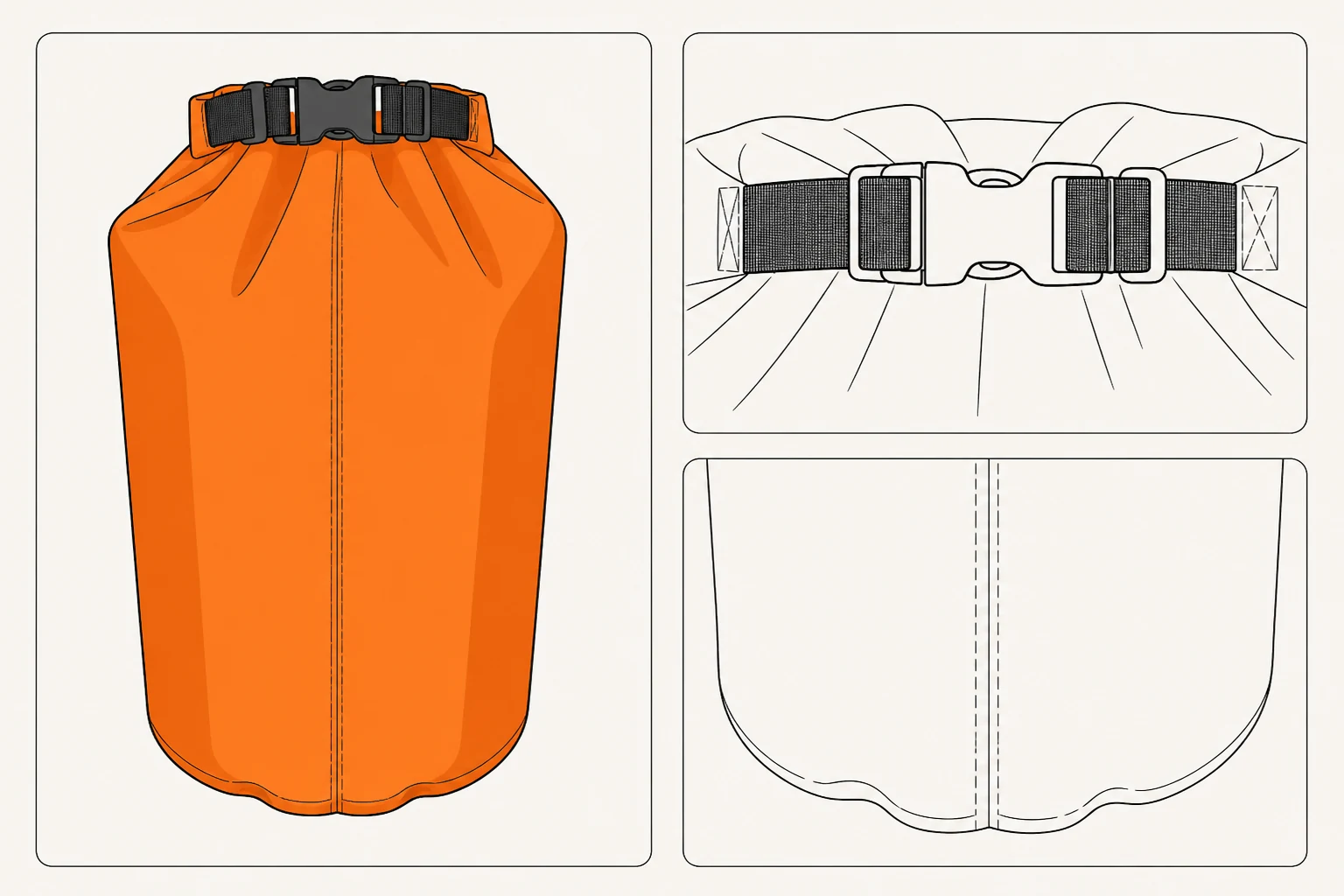
Work backward from the loaded, rolled, buckled and packed dry bag
Resolve use case, capacity route, material, seam and base construction, mouth width, roll sequence, buckle, webbing and strap, print and label, leak-screen method and packed SKU before approving color or nominal volume.
Keep material, seam coupon, assembled bag, closure sample, leak-screen record and packed SKU separate
A material swatch cannot prove seam behavior; a loose buckle cannot prove the rolled closure; and an empty bag photograph cannot prove loaded geometry, screening results or the delivered pack.
01
Identify the base textile
Record declared fiber, yarn and weave route, fabric mass or other buyer-controlled basis, color, finish and supplier code. Preserve face/back references and avoid inferring fiber or strength from hand feel.
02
Identify the barrier layer
Define coating, laminate or film type in supplier-controlled language; application face; nominal build; texture; color; and compatibility with welding, taping, printing, folding and cleaning.
03
Control panel allocation
Map body, base, roll-top, reinforcement, pocket and strap panels to material codes. A stronger-looking base or shiny face cannot substitute for a released bill of materials and evidence scope.
03 / seam construction
Choose welded, stitched-and-sealed or hybrid seams through the actual material system
Seam performance depends on fabric/coating compatibility, overlap, process window, geometry, handling and inspection. Buyers should control the seam route by location rather than assuming that one process fits every panel.
- 01Freeze material pair
- 02Map seam geometry
- 03Set controlled process route
- 04Inspect complete bag
01
Map every seam family
Separate long body seams, base joins, corners, roll-top attachment, strap anchors, accessory patches and print zones. Record overlap, fold, stitch or weld geometry and the approved process for each.
02
Control the process window
For welded seams, define equipment route, energy or temperature/time/pressure controls in supplier-approved terms and coupon-to-bag traceability. For stitched routes, define thread, needle, stitch, tape or sealant and curing/handling.
03
Inspect complete geometry
Check continuity, skipped or burned zones, wrinkles, channel paths, edge distance, corner transitions, trapped contamination and distortion. Coupon evidence cannot replace the finished seam around real curves and attachments.
04 / roll-top closure
Dimension mouth stiffness, roll allowance, buckle path and loaded closure geometry
The roll-top is a mechanism, not a decorative strip. Top width, reinforcement, folding memory, webbing, buckle position, usable rolls and packed contents determine whether the closure is repeatable.
| Closure decision | Required relationship | Typical evidence gap |
|---|---|---|
| Open mouth | Flat mouth width, top reinforcement, material orientation and seam interruption are dimensioned together | Capacity claim without usable opening dimensions |
| Roll sequence | Edge alignment, air removal, minimum approved rolls and rolling direction are specified | Closed photograph without the required roll procedure |
| Buckle closure | Buckle type, webbing length, attachment position and final connected geometry are linked | Loose buckle without the complete rolled mouth |
| Loaded state | Representative content volume, shape, roll allowance, buckle reach and carrying clearance are recorded | Empty bag treated as loaded closure evidence |
| Repeated operation | Opening, rolling, buckling and unloading observations use the agreed sample and method | One setup photograph without repeat observations |
01
Dimension the open mouth
Record flat width, top-edge reinforcement, seam interruption, material orientation, webbing position, buckle type and tolerances. Check that the mouth opens for loading without damaging coated surfaces.
02
Control the rolling sequence
Define edge alignment, air removal if applicable, minimum buyer-approved rolls, roll direction, buckle connection and final handle or side-clip geometry. Capture the exact procedure in sampling and instructions.
03
Check the loaded closure
Test representative content volume and shape. Confirm roll allowance, buckle reach, webbing tension, corner alignment, carrying clearance and repeated opening without claiming protection beyond the agreed method.
05 / capacity and shape
State nominal and usable capacity with one transparent measurement convention
A liter label can be calculated from ideal dimensions, pattern volume or a physical fill method, and these routes can produce different results. The buyer must specify the convention and usable closure allowance.
- 01Choose capacity convention
- 02Measure finished geometry
- 03Reserve closure allowance
- 04Approve label wording
01
Name the capacity method
State whether volume is calculated from controlled finished dimensions, checked with approved neutral media or determined by another buyer method. Record bag posture, roll allowance and repeatability.
02
Separate nominal from usable
Reserve space for the required closure and irregular contents. Define whether external pockets, tapered shoulders, rounded bases and compression are included or excluded from the published figure.
03
Control the finished shape
Dimension lay-flat width, diameter or depth, body height, base geometry, open height, closed height and strap envelope. Check that size names remain consistent across artwork, labels and cartons.
06 / carrying hardware
Control buckles, webbing, straps, anchors and accessory points separately from water claims
Carrying components affect usability and seam loading. Their material identity, geometry, attachment and load assumptions need separate records from fabric water-resistance evidence.
01
Specify closure hardware
Record buckle family, material, size, mating parts, color, supplier code, webbing width and assembly direction. Check engagement, release and interference after the top is rolled.
02
Map carrying loads
Define shoulder, backpack, hand-carry and attachment use; strap range; padding; anchor geometry; and buyer-approved load/handling route. Do not represent accessory D-rings as climbing or rescue hardware.
03
Protect coated panels
Review patches, welds, stitches, edge finishes and reinforcement around every anchor. Check abrasion, sharp corners, fold interaction and leakage risk under the agreed handling sequence.
07 / inspection and packing
Release each size, color and accessory set against a complete closure comparator
The delivered SKU includes bag body, roll-top, buckles, straps, print, labels, polybag and carton. Inspection must preserve the relationship among these objects and the approved closure procedure.
| Release object | Controlled fields | Buyer decision | Status |
|---|---|---|---|
| SKU and capacity route | Model code, nominal capacity, usable dimensions, color and revision | Confirms the quoted bag configuration | Resolved / open |
| Material and seams | Face material, coating or laminate, seam route, base construction and reinforcement | Identifies the supplied construction | Matched / unmatched |
| Roll-top hardware | Mouth geometry, approved roll count, buckle, webbing, strap and attachment positions | Links closure procedure to the complete bag | Accepted / conditional |
| Leak-screen record | Sample identity, method, duration, loading state, observations, owner and date | Bounds the screening result without universal claims | Current / gap |
| Packed SKU | Print, label, instructions, fold, bag, carton, count and released comparator | Connects the approved bag to delivery | Released / hold |
01
Separate approval objects
Track raw textile, coating or laminate, seam coupons, assembled bag, closure sample, leak-screen sample, printed unit and packed shipment as distinct but linked records.
02
Inspect critical characteristics
Check SKU, size, dimensions, material face, seams, base, top edge, buckle, webbing, strap, attachments, print, labels, closure operation, cleanliness, bag and count.
03
Retain the released comparator
Archive open, rolled, buckled, front, back, base, seam, hardware and packed views plus controlled records so reorders use the correct construction and procedure.
08 / RFQ and continuity
Carry claim scope, material and closure controls into quotations and reorders
Two offers are comparable only when they use the same exposure, claim, textile/barrier system, seam route, roll-top geometry, capacity convention, hardware, test plan and packing.
- 01Release one controlled RFQ
- 02Compare closed finished samples
- 03Lock material and closure records
- 04Reopen affected lanes on change
01
Issue one controlled matrix
List contents, exposure, claim, fabric, coating or laminate, panels, seams, top, rolls, buckle, capacity method, dimensions, straps, artwork, evidence, packing and quantity.
02
Price alternatives separately
Separate textile, coating, seam, size, buckle, strap, print and pack options. Show sampling, test and reapproval consequences beside any cost difference.
03
Require change notice
No textile, coating, seam process, top reinforcement, buckle, webbing, pattern, print, supplier, factory or packing change should enter production before affected owners review it.
Visibility and safety-claim boundary
Coated fabric, sealed-looking seams and trapped air can support only the exact finished-bag exposure claim validated under a defined closure procedure. A photograph, fabric report or staged packing view does not establish immersion protection, guaranteed flotation, rescue use or protection of sensitive contents for an EverBen dry bag.
Route-specific FAQ
Checks before dry bag material and roll-top construction approval
Does roll-top mean waterproof?
Not by itself. Protection depends on fabric, coating or film, seam route, top construction, number and quality of rolls, buckle geometry, loading, handling, exposure and the exact test method used for the finished bag.
Can a dry bag be described as submersible?
Only when the exact finished construction, closure method, depth, duration, conditioning and acceptance criteria are validated for that claim. Ordinary roll-top bags should not inherit immersion claims from fabric data.
Which is better, coated nylon or coated polyester?
There is no universal winner. Define base fabric, yarn and weave, coating or laminate, mass, hand, abrasion route, hydrostatic or other buyer-required evidence, seam compatibility, color, print and cost for the intended use.
How many times should the top be rolled?
Use the buyer-approved procedure for the exact top width, stiffness, buckle route and loading condition. The page illustrates a controlled sequence but does not create a universal number for every bag.
Does nominal liter capacity equal usable capacity?
Not necessarily. The capacity convention, roll allowance, closure clearance, shape, contents and packing method affect usable volume. State how the value is calculated or physically checked.
Can a dry bag be used as a flotation or rescue device?
No, unless a separate exact system is designed and validated for that purpose. A bag that traps air or floats temporarily is not a life jacket, buoyancy aid or rescue product.
What should pre-shipment inspection include?
Check SKU, dimensions, fabric, coating face, seams, base, roll-top edge, buckle, webbing, strap, attachment points, print, labels, closure operation, agreed leak-screen route, cleanliness, bag and carton count.
What changes require reapproval?
Base textile, coating or film, color, seam process, tape, adhesive, top reinforcement, buckle, webbing, strap, attachment, pattern, print, factory, process or packing changes can reopen affected decisions.
Application decision
Convert a generic waterproof-bag request into a controlled sourcing brief
Send intended contents, exposure, closure procedure, allowed claim, fabric and coating route, seam construction, roll-top geometry, capacity method, dimensions, carrying hardware, test plan, artwork, inspection, packing and quantities. EverBen can organize these fields into comparable samples and release records.