
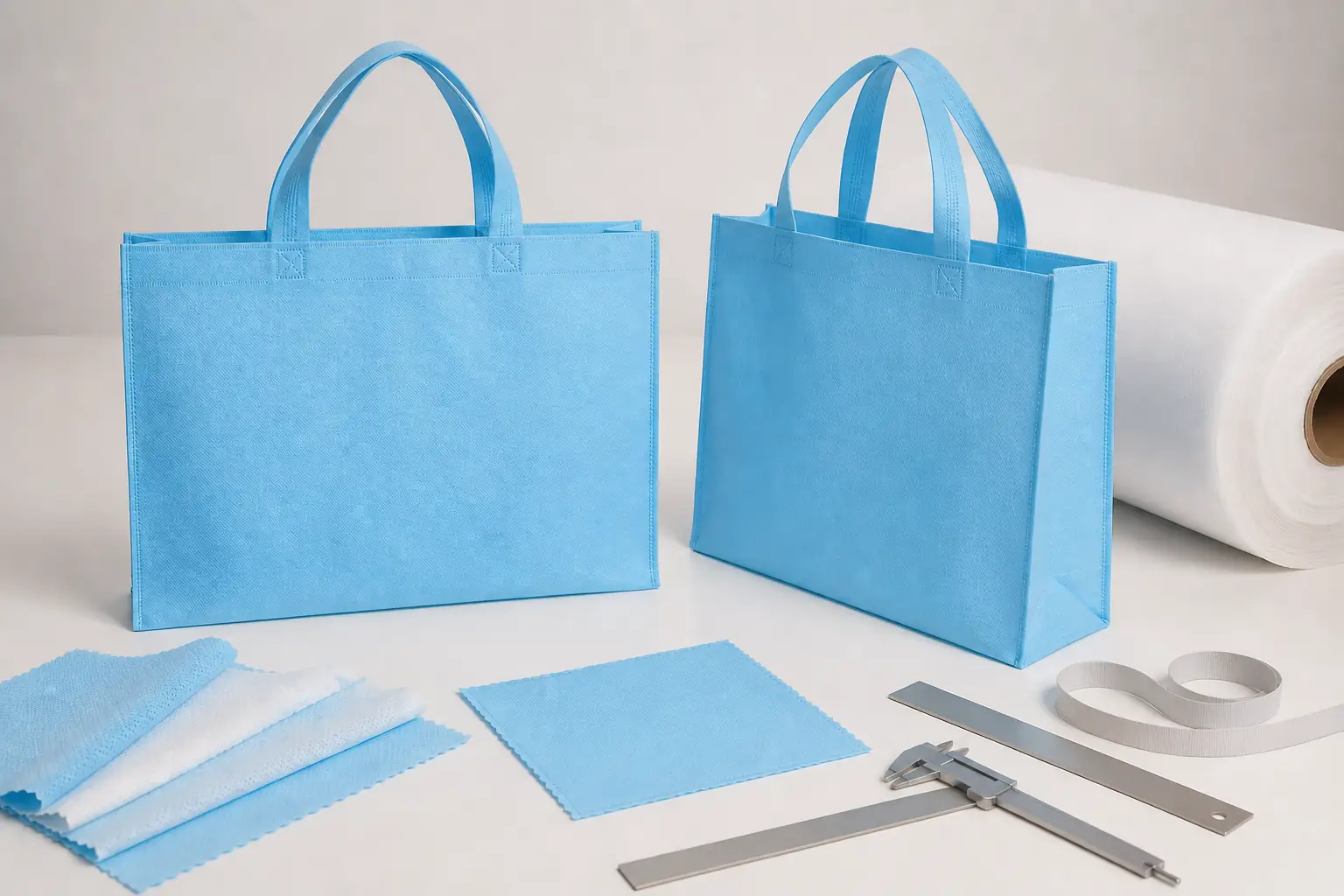
BUYING GUIDE / SHOPPING BAG MATERIAL, HANDLES AND PRINTING
How to Choose Nonwoven, Cotton or Polyester Promotional Shopping Bags
A material name does not define the carried load, bag volume, handle comfort, seam route or printed result. Buyers need a use map, a controlled complete bag, measurable construction and approval evidence from the exact packing program.
This guide separates material identity, fabric weight, dimensions, gussets, base, handles, seams, printing, reuse language and packing. It helps sourcing teams compare supplier offers without treating nonwoven, cotton or polyester as a universal ranking.
01 / use boundary
Define distribution, contents and carrying event before choosing material
A conference giveaway, grocery program, retail purchase bag and reusable travel tote face different contents, dwell, handling and presentation. Start with the actual carrying route and claim boundary.
- 01Define campaign and channel
- 02Build representative load
- 03Map carry and storage
- 04Freeze the use boundary
01
Name the program role
Record campaign, channel, distribution, wearer or carrier, reuse expectation, storage and destination. Keep marketing objectives separate from unsupported durability or environmental claims.
02
Describe representative contents
List typical item geometry, mass distribution, edges, temperature and leakage risks. Use a controlled load set rather than a vague heavy-duty description.
03
Map the carrying event
State carry duration, handle use, shoulder or hand contact, lifting, setting down, nesting and storage. These facts guide construction and trial design.
02 / material identity
Compare nonwoven, cotton and polyester as distinct material systems
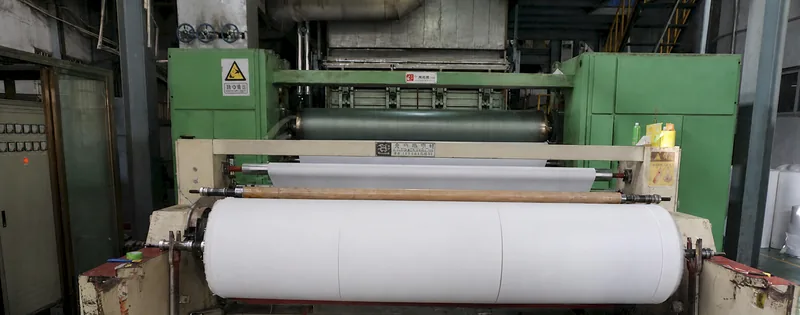
The three routes differ in structure, surface, sewing, printing, care and pack volume. Require exact supplier codes, weight basis and complete bag references for every option.

Work backward from the delivered loaded and printed bag
Resolve shopping-bag shorthand to campaign, contents, carry route, material code, weight basis, complete geometry, handles, seams, artwork, print route, packed reference and approval owner.
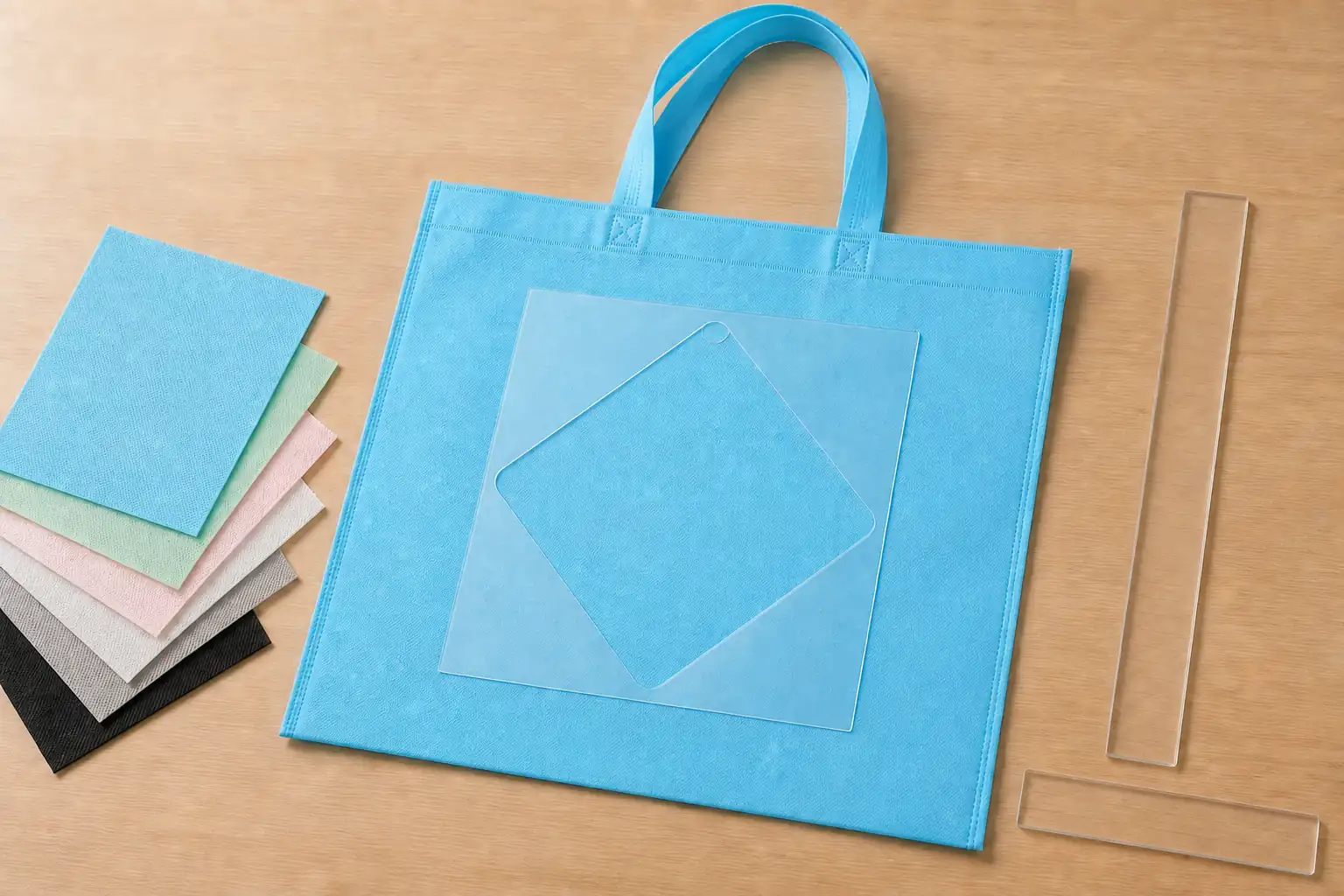
Keep swatch, blank bag and printed-bag approval distinct
A swatch cannot prove complete load paths, a blank bag cannot prove print interaction, and a mockup cannot prove handle use, fold, packing or delivered presentation.
01
Control nonwoven identity
Record polymer and spunbond or other offered construction wording, weight basis, finish, supplier code and color reference to the supported level. Avoid treating a family name as a performance claim.
02
Control cotton route
Identify fiber wording, yarn, weave, weight convention, finish and supplier code. Keep sourcing, organic or environmental statements open until article-specific evidence is approved.
03
Control polyester route
Record woven construction, yarn, weight, coating or finish where offered, surface and care. Similar-looking bags can behave differently when textile and finish change.
03 / bag geometry
Engineer finished dimensions, opening, gussets and base around real contents
Flat width and height do not describe usable volume. Side folds, bottom construction, seams and opening determine how contents enter, stand and distribute load.
- 01Freeze representative contents
- 02Set finished geometry
- 03Assemble complete sample
- 04Verify fit and presentation
01
Dimension the complete bag
Record finished width, height, depth or gusset, base and opening from named landmarks with tolerance and bag condition. Distinguish flat from erected measurements.
02
Choose gusset and base route
Define flat, side-gusset, box-bottom or another approved construction with complete pattern and assembled views. Inspect fold lines, corner bulk and base support.
03
Run a contents fit check
Load the representative item set without forcing the opening or hand reshaping. Record access, closure, bulging, base stability and presentation as observable states.
04 / load path
Control handles, attachments and seams as one load path
A strong handle cannot compensate for an unsuitable body fabric or attachment. Review material, width, length, placement, sewing and representative load together.
| Decision row | Required relationship | Gap indicator |
|---|---|---|
| Contents | Representative geometry, mass and distribution resolve to the complete bag | Generic heavy-duty wording |
| Handles | Material, width, drop, placement and attachment share one revision | Handle sample only |
| Body and seams | Material, gussets, base and seam route carry the stated load path | Body fabric approved in isolation |
| Trial | Load, sequence, cycles, conditions and observations are recorded | Capacity number without method |
| Continuity | Material, pattern, component and process changes trigger review | Silent construction substitution |
01
Specify handle geometry
Record material, width, length, drop, fold, edge and placement from fixed landmarks. Check hand or shoulder contact under the intended loaded condition.
02
Define attachment
Identify sewn area, reinforcement, stitch route, thread and reverse appearance. Review attachment distortion and hard points on the complete bag rather than isolated samples.
03
Map every structural seam
Control side, base, gusset, binding and opening routes with allowance and workmanship references. Connect inspections to the represented load path.
05 / use evidence
Plan a representative load and handling trial without inventing capacity claims
A load statement is meaningful only with contents, distribution, sequence, cycles, conditions and acceptance. Treat proposed values and verified results separately.
- 01Identify sample and load
- 02Run agreed handling sequence
- 03Inspect complete bag
- 04Record represented decision
01
Build the load fixture
Use defined masses and shapes that represent the program. Record placement, support, closure, handle route and sample identity before each trial.
02
Simulate the handling sequence
Define lifts, carries, sets, dwell, repetitions and observations relevant to the buyer. Avoid publishing a universal capacity from an unrelated or undocumented test.
03
Inspect complete change
Observe handle attachment, seams, base, distortion, print, closure and retained contents. Preserve raw records and decision ownership for the exact sample revision.
06 / artwork execution
Select print route through artwork, material surface and finished-bag evidence
Ink, transfer and other decoration routes interact differently with nonwoven, cotton and polyester surfaces. Approve production-scale work on the exact bag material and color.
01
Preflight artwork
Record file owner, dimensions, placement landmarks, colors, coverage, underbase needs and permitted simplification. Preserve revisions from mockup through production trial.
02
Trial on exact material
Review detail, opacity, edge, color, hand, reverse effect, registration and fold interaction. A paper proof cannot represent the textile surface or seams.
03
Check use and pack interaction
Inspect print after representative handling, folding and any agreed care route. Record blocking, transfer, cracking or visible change without inventing universal results.
07 / release evidence
Connect sample gates, inspection and packing to one delivered bag revision
The delivered scope includes material, complete construction, print, fold, inner pack, assortment and carton. Component approval cannot replace the finished packed product.
| Entity | Required attributes | Decision value | Review state |
|---|---|---|---|
| Program | Campaign, channel, contents, carrying event and claim boundary | Defines the represented merchandise route | Clear / open |
| Material | Identity, supplier code, construction, weight, finish and color | Defines the controlled body route | Matched / unmatched |
| Complete bag | Dimensions, gussets, base, handles, seams and closure | Bounds structural approval | Approved / conditional |
| Decoration | Artwork, process, placement, handling and packed comparator | Defines delivered-merchandise approval | Current / gap |
| Continuity | Material, pattern, component, print and reapproval controls | Preserves the accepted relationship | Active / reapproval due |
01
Separate approval gates
Control swatch, blank complete bag, loaded trial, printed sample and packed unit as different objects. Assign revision, owner and recorded decision to each.
02
Inspect critical characteristics
Check material code, weight basis, dimensions, gussets, base, handles, seams, color, artwork, print, count and packing against written references.
03
Retain the packed comparator
Seal an approved bag with fold, insert, sleeve or bundle, assortment and carton allocation. Preserve untouched views and archive custody for reorders.
08 / commercial continuity
Carry material, geometry, load and print controls into RFQ and reorder
Comparable quotations require identical scope, explicit alternatives and visible open fields. Reorders remain valid only while every governed relationship stays current.
- 01Issue controlled shopping-bag RFQ
- 02Review complete samples and evidence
- 03Freeze one production revision
- 04Reapprove affected changes
01
Issue one bag matrix
List program, contents, load, material, weight, dimensions, gusset, base, handles, seams, closure, color, artwork, print, evidence, packing, quantity and destination.
02
Price alternatives separately
Separate material, weight, handle, reinforcement, closure, decoration, testing and packing options. Evaluate savings with sample and reapproval consequences.
03
Control every change
Require written notice before material, supplier, weight, finish, pattern, component, seam, print chemistry, process, site or pack changes. Reapprove affected lanes.
Limits of shopping-bag shorthand
Nonwoven, cotton, polyester, reusable and heavy-duty language can organize discussion, but they do not qualify an EverBen bag or publish universal load, reuse, environmental or print results. A purchasing conclusion depends on the exact campaign, contents, carry route, material identity, weight basis, complete geometry, handles, seams, load trial, artwork, print route, packing, destination, acceptance owner and buyer-approved wording.
Route-specific FAQ
Checks before shopping bag material, construction and print approval
Is nonwoven always the lowest-cost shopping bag route?
No universal cost ranking is published here. Material grade, weight, size, handles, seams, print, packing, quantity and destination determine the quoted route.
Is cotton automatically the most sustainable option?
No. Material identity does not prove sourcing, reuse, impact or end-of-life claims. Any statement needs an exact product scope and supporting evidence.
When is polyester useful?
Woven polyester can support compact reusable constructions, but suitability depends on load, seams, coating or finish, printing, care and packing for the exact project.
How should bag size be specified?
Record finished width, height, gusset or depth, opening, base and tolerance from named landmarks, plus the bag condition and intended contents.
Does a reinforced handle guarantee load capacity?
No. Handle material, width, length, attachment, body fabric, seams, load distribution and test method work together.
Which printing method is best for totes?
No universal method is selected. Artwork, color, material, surface, hand, order size, wash or reuse plan and pack determine which trials to compare.
What changes reopen approval?
Material, weight, finish, dimensions, gusset, base, handle, thread, seam, closure, print chemistry, artwork, color, packing or site changes can reopen affected decisions.
What belongs in a shopping-bag RFQ?
Include campaign, contents, load, material, weight basis, dimensions, gusset, base, handles, seams, closure, artwork, print, evidence, packing, quantity, destination and change controls.
Construction decision
Convert a promotional bag idea into a controlled material, construction and print brief
Send the campaign and distribution route, typical contents, load and carrying event, material options, finished dimensions, gusset and base, handles, seams, closure, artwork, print route, reuse and care plan, packing, quantity and destination. EverBen can organize these inputs into measurable sample and release gates.